


We provide smart technology for homes and commercial spaces, ensuring transparent processes and optimal resource management.
EV CHARGER · TWO TYPE 2 SOCKETS · DYNAMIC LOAD BALANCING
Two cars share one charger, intelligently
22 kW when alone · Balanced when both plugged in
Saves about £805 versus installing two singles
£2,073 dual vs ~£2,878 for two separate units
One install day, not two — one wall, one cable
Both cars charge full speed if one is plugged in alone
Socket-priority logic, not fixed 11/11 split
Modular UCP platform — same DNA as fleet chargers
Type 2 sockets fit every modern EV in the UK
IEC 62196-2 · Two cars, any brand, any combination
Smart load balancing protects the main house fuse
Backs off charging if oven and hob hit peak
Future-proofed for two-EV households before they own two EVs
At install the charger reads the property's electrical supply — single-phase 230 V or three-phase 400 V. On a three-phase supply (common in newer builds and most properties with two EVs), each socket can deliver up to 22 kW at 32 A per phase. On a single-phase supply each socket caps at 7.4 kW. The dual unit is most often specified for properties with three-phase supply, where the speed difference between dual and single is genuinely meaningful for households running two cars.
First car plugs into socket A. With the other socket empty, the charger delivers the full available power to socket A — up to 22 kW on three-phase, 7.4 kW on single-phase. Same speed as a dedicated single-socket Octa Wall. This is the normal weekday pattern: one car at home charging overnight while the other is parked elsewhere or out on the road.
Second car arrives, plugs into socket B. The dynamic load management (DLM) splits available power between the two sockets — by default, 50/50 (11 kW each on three-phase). Both cars charge in parallel, both finish overnight on a typical 8-hour stand. Optional priority modes in the app let one car take precedence (the morning commuter car always gets first allocation; the weekend-only car gets the leftover).
Beyond the dual-socket internal split, the charger also reads total household current via the CT clamp. If the heat pump compressor cycles on, the oven hits peak, or the home battery decides to charge — the dual unit backs off proportionally to keep total demand within the main fuse rating. Whole-house DLM that knows both cars and every other major load simultaneously.
Solar surplus diverts into the cars by default — both sockets receive a share. When only one car is plugged in, all surplus goes to that one. When both are plugged in, the app's priority setting decides — surplus to the lower-charge car first, or to the morning commuter car, or split 50/50. Solar surplus that exceeds both cars' acceptance exports to grid under SEG as normal.
Each socket has its own schedule. Car A can run on Octopus Intelligent Go (overnight 7p/kWh, supplier-scheduled); car B can run on Octopus Agile (homeowner-scheduled around cheapest 4-hour window). Or both on the same tariff. Or one on solar-only mode, one on grid-overnight. The two sockets are functionally independent in the app — even though they share the same chassis and supply.
Same OCTA app as the Single, with an extra layer of dual-socket coordination — priority modes, per-socket scheduling, per-car session reporting. Both sockets share one Wi-Fi connection, one cloud account, one set of session history.
OCTA app · per-socket control
Each socket appears as a separate device in the app. Live view of each charge session — current draw, kWh delivered, time to full, cost at the active tariff. Schedule per socket, configure solar diversion per socket, set RFID authorisation per socket. Treats the dual unit as two independent chargers sharing infrastructure.
Three load-balancing modes
Even split (default — both cars get equal share when both plugged in), priority A (socket A takes precedence, socket B gets leftover), priority B (mirror). Useful for households where one car needs reliable overnight charge (commute) and the other is flexible (weekend leisure). Switchable per session in the app.
Solar diversion · two-car
Read the inverter's export figure and divert surplus into whichever car is plugged in. If both, split per the priority mode. If only one, all surplus to that one. Particularly powerful for households with a permanent at-home car (work-from-home partner) and a commuter car — the at-home car gets the daytime surplus, the commuter car gets the overnight cheap grid.
Per-socket tariff scheduling
Each socket schedules independently. Car A on Octopus Intelligent Go (supplier-scheduled overnight at ~7p/kWh), Car B on Octopus Agile (home-scheduled cheapest 4-hour window). Different cars, different drivers, different schedules — but one charger, one circuit, one notification.
Whole-house DLM
Beyond the internal A/B socket split, the dual unit reads total house current via the CT clamp. Adjusts combined output to keep house demand within the main fuse rating — typically 80–100 A on UK supplies. Even with both cars plugged in at full draw plus heat pump plus oven, the system rebalances rather than tripping.
Per-car session history
Sessions tagged by socket — useful for households where one car is a personal vehicle and the other is a company car requiring HMRC-recognised charging expense claims. Monthly CSV downloads separable by socket. Avoids the messy "which car did this session belong to" problem that two single chargers on shared accounts can create.
RFID per socket
Each socket has its own RFID authorisation pool. Useful when one socket is for the household and the other is for visitors or shared use. Up to 16 cards per socket, 32 in total. Combined with per-socket session reporting, the dual unit handles "one for us, one for guests" driveway without billing complexity.
OCPP 1.6J upgrade path
Same firmware upgrade path as the Single — the dual unit can be upgraded to OCPP 1.6 JSON for per-session billing. Particularly useful for landlords running two-EV tenant properties or small businesses with employee-pool EV charging. The upgrade turns each socket into a separately-billable bay through compliant back-offices (Monta, Driivz, EV.Energy).
Cloud + 4G backup
Wi-Fi for primary cloud connectivity, optional 4G LTE module as backup. Both sockets share the same network module — one Wi-Fi credential, one cloud uplink, one OTA firmware path. Reduces the maintenance overhead of running two separately-connected chargers. OTA updates roll out simultaneously to both sockets.
Seven components make up the Octa Wall Dual — two Type 2 sockets, the AC supply, the CT clamp, earthing, the network module, and the solar inverter link. The big architectural distinction from the Single: one supply cable, one circuit, one breaker feeds both sockets internally via the dual-channel UCP electronics.
1 · Socket A
Left-side Type 2 IEC 62196-2 socket. Untethered — user brings own Type 2 cable. Independent in the app — schedules, RFID pool, session history all per-socket. Hardware-wise it shares the AC supply, breaker, and CT clamp with socket B; the UCP electronics route current dynamically based on what's plugged in and the active DLM mode.
2 · Socket B
Right-side Type 2 socket, fully independent of socket A in the app. Mirror image hardware-wise. The dual unit's value is that both sockets are equally capable — neither is a lite version of the other. Either socket can be primary, either can be priority, either can charge a 22 kW-capable car at full speed when alone.
3 · Single AC supply
One SWA cable run from the consumer unit feeds both sockets. Typically 10 mm² three-phase or 16 mm² single-phase to handle combined load. One dedicated breaker (40 A three-phase or 63 A single-phase), one Type A RCD upstream. The single supply is the structural reason a dual saves £805 — one cable, one breaker, one DNO notification instead of two of each.
4 · CT clamp · whole-house
Single CT clamp on the property's incoming tail, read by the dual unit to manage total house current. The dual's DLM works on two layers: A/B internal split (between sockets), plus house-aware throttle (whole property). Without the CT clamp the dual runs at fixed maximum rate — fine for properties with plenty of headroom, problematic for tight installs.
5 · PEN fault protection
Open-PEN detection on TN-C-S supplies — single point of protection for both sockets, since they share the supply. Disconnects both sockets simultaneously if a supplier-side PEN fault is detected. Eliminates the need for an earth rod on most UK installs. Critical for outdoor wall-mount where cars are connected for extended overnight periods.
6 · Network + inverter link
Wi-Fi 2.4 GHz, Ethernet RJ45, optional 4G LTE — shared by both sockets. Single connection to the OCTA cloud, single OCPP back-office endpoint when activated, single inverter API link for solar diversion. Both sockets read the same inverter export figure and split the surplus between them per the active priority mode.
7 · Cable: Tethered vs Untethered
Untethered (Socket) — £2,073 total. Both drivers bring their own Type 2 cables; cables live in boots when not in use. Flexible for two-EV households where the cars may change over time, or where one car spends time away from this driveway. No dangling cables on a visible side return — particularly clean for conservation or street-frontage installs.
Tethered (with Cable) — £2,173 total. Both sockets fitted with fixed 5 m or 7.5 m Type 2 cables. Faster plug-in for every session, no cable routine when both drivers arrive at the end of a long day, cleaner daily user experience for two-driver households. The right pick when both cars are long-term residents of this driveway and the +£100 uplift is justified by daily convenience across two cars.
Same coverage as the Single, with the structural advantage that one warranty, one service plan, one set of spare parts covers both sockets. CleverBloom service plans and extended monitoring available — quoted alongside the install.
3 year manufacturer warranty
OCTA warrants the Octa Wall Dual for 3 years from commissioning. Single warranty covers both sockets, the dual-channel UCP electronics, the load-management logic, and the network module. Single warranty registration, single point of contact for warranty claims. Spare parts hold in UK stock through CleverBloom's distributor channel.
PEN fault protection · no earth rod
Built-in open-PEN detection meets BS 7671:2022 amendment 2 for both sockets — single point of protection rather than two separate earth rods if installing two singles. Substantial cost saving (£200–£400 of earth rod work avoided) and no garden disruption. Particularly relevant for two-car driveways where two separate earth rods would be visually intrusive.
UCP modular platform
Same modular electronic architecture as the entire OCTA range — the UCP dual-channel variant used here also runs in the commercial Smart Wall 44 kW Dual and the Smart Wall 66 kW Triple. Field-proven at fleet operating intensity (Volvo, Jaguar, Land Rover commercial sites) applied to the home dual product. Shared spare-parts pool with the commercial range.
IP54 weatherproof · both sockets
Whole enclosure IP54-rated. Both sockets protected against dust ingress and water splash. Suitable for unsheltered outdoor wall-mount. Operating range −25°C to +50°C handles UK weather extremes. Single weatherproof seal — fewer ingress points than two separate single chargers each with their own seal lines.
Wall-mount load engineering
A dual unit is heavier than a single (around 12 kg vs 6 kg) and the wall fixing carries the weight of both cables when both cars are plugged in. Mounting must engage a structural wall (brick, block, structural timber stud) — surface-fixed to render or weatherboard isn't suitable. Engineer verifies wall composition at fit day before final mounting position is confirmed.
Cable-management discipline
Two cables, two cars — the dual is the configuration most likely to suffer cable trip hazards or door-strike damage. Cable hooks beside each socket are standard install practice; floor-mounted cable channels for high-traffic walkways are quoted as an optional extra. The cable-management detail is a 30-minute install decision that determines whether the unit looks tidy across years of daily use.
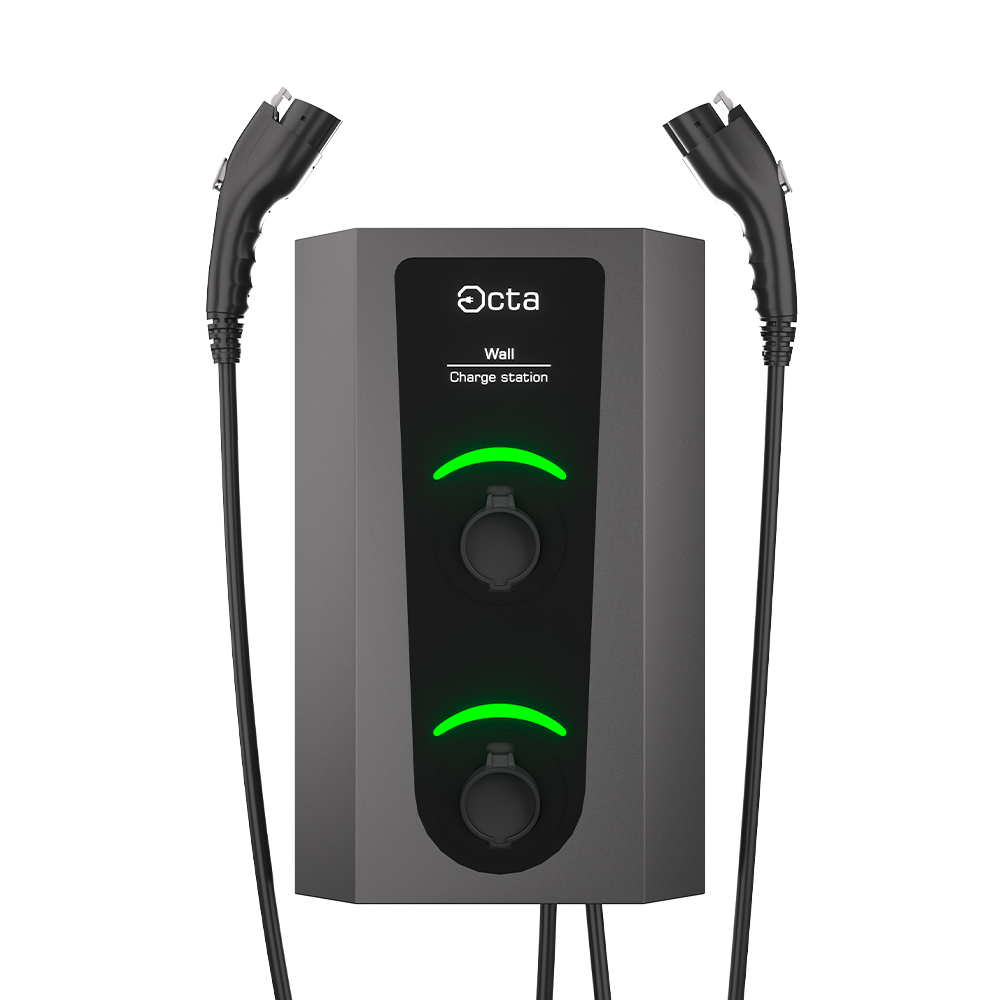
£2,173
Octa Wall 44 kW Dual Tethered + dedicated circuit · fixed 5 m cables × 2 (7.5 m optional) · +£100 vs Socket variant
£2,073
Octa Wall 44 kW Dual Socket + dedicated circuit · two-car install · saves ~£805 vs two separate Octa Wall 22 kW Single installs


_11zon%20(1).webp)
Call us at 07526 985258
or leave your contact information below,
and we'll get back to you soon.
We provide smart technology for homes and commercial spaces, ensuring transparent processes and optimal resource management.
Working hours: Mon - Sun. 8am - 8pm
Proudly serving the entire UK!
© 2026 Clever Bloom — All rights reserved
Company registered in England and Wales / Company number: 14242566.