


We provide smart technology for homes and commercial spaces, ensuring transparent processes and optimal resource management.
INTERNAL WALL · CALCIUM SILICATE · MOISTURE-MANAGING
Calcium silicate internal wall insulation · capillary-active moisture management · A1 fire · 100-year design life
Pulls condensation off the wall surface and stores it
Capillary-active · Self-regulating buffer
A1 non-combustible — fits leasehold blocks above 11 m
No EWS1 friction · No height limit
Mould can't grow on an alkaline mineral surface
pH 10 · Anti-fungal by chemistry, not coating
Brings Victorian solid brick close to Part L 2022
U-value ~0.50 W/m²K at 50 mm
Plasters direct — finishes like a normal wall
No vapour barrier · Lime or gypsum skim
100% mineral — no plastics, no resins, no off-gassing
Inorganic · 0 VOC · Cradle-friendly
Vapour-open at lime-mortar equivalence
μ ≈ 3 · Matches Victorian construction
100-year design life · made in the Netherlands
Clima Redboard Pro is internal wall insulation — applied to the room side of the external wall. The original masonry sits outside the new thermal envelope. Heritage external appearance is preserved entirely. From inside the room, the wall moves inward by ~55 mm (50 mm board plus 2–3 mm plaster skim). Modest loss of internal space for a Part L upgrade on solid-wall stock.
Calcium silicate's defining property — micro-pore structure actively pulls liquid water and water vapour into the board through capillary action. Where rigid foams and even wood fibre just resist condensation, calcium silicate manages it. The board becomes a self-regulating moisture buffer between the room and the cold brick behind.
When the room air drops below saturation, stored moisture in the board's pore network releases back as vapour. The cycle runs continuously — surface humidity buffered, peaks softened, room-corner condensation prevented. This is why calcium silicate is specified on damp solid walls where vapour-open-but-passive insulation (mineral wool, wood fibre) still leaves the surface wet.
The board surface sits at pH ~10. Mould species need a pH closer to neutral and an organic food source to colonise — calcium silicate offers neither. Even when the board surface is intermittently damp (which is its job), it doesn't develop the black-spot mould patterns that plague poorly-ventilated Victorian rooms. The anti-mould behaviour is chemistry, not a coating.
Pure calcium silicate is non-combustible Euroclass A1. No 11 m external wall height restriction, no EWS1 form friction, no leasehold consent complications around fire-class of fabric upgrades. The single most important spec advantage on mansion-block and multi-occupancy work, where the freeholder's fire-engineering report has to clear the build-up.
The board face accepts standard gypsum plaster (Thistle Multi-Finish) or lime plaster directly — no vapour barrier, no special primer. Standard wallpaper, breathable paint, normal radiator and shelving fixings. After plaster cure the wall behaves like any other plastered solid wall, just warmer, drier, and mould-resistant.
1 · Substrate prep
Existing internal plaster removed back to masonry. Loose pointing made good. Old gloss paint mechanically abraded. Salt-affected areas treated with a salt-neutralising base render at low level if the damp survey flagged historic rising-damp loading. The substrate condition matters — damp + salts + sealed IWI is the failure pattern we avoid.
2 · Salt & damp survey
Calcium silicate is more forgiving of damp substrates than rigid foams (you can't trap moisture behind a capillary-active board the way you can behind PIR), but salt loading still matters. Hygroscopic salt test kit run at sample points before fixing. Affected low-level masonry gets a render pre-treatment.
3 · Adhesive bed
Redstone-specified calcium-silicate-based adhesive applied to the back of each board. Full-coverage on uneven substrates — no air gap behind the board (an air gap defeats the capillary cycle). Boards pressed into the bed, plumbed, levelled, butted tight at joints. Adhesive sets within 24 hours.
4 · Mechanical fixings (optional)
Most installs adhesive-only; mechanical fixings added on weak or uneven substrates where the adhesive bed alone isn't trusted. Polymer plug-and-pin fixings drilled through the board face into the masonry, flush-set, hidden by the plaster skim. No thermal bridge, no corrosion path.
5 · Joint reinforcement
Self-adhesive scrim tape over every butt joint and at perimeters where new IWI meets original wall plane. The scrim and the board face together give the plasterer a continuous, paper-tested surface. No need for skim-coat reinforcing mesh on flat wall planes; mesh corner beads at returns.
6 · Plaster finish
Standard gypsum plaster skim (Thistle Multi-Finish) for general retrofit. Lime plaster (Mike Wye, Singleton Birch) for listed-building consents where vapour-open finish is specified. Both bond directly to the calcium silicate face. Finished thickness 2–3 mm. Decorate normally — breathable paint or paper.
Calcium silicate hydrate matrix
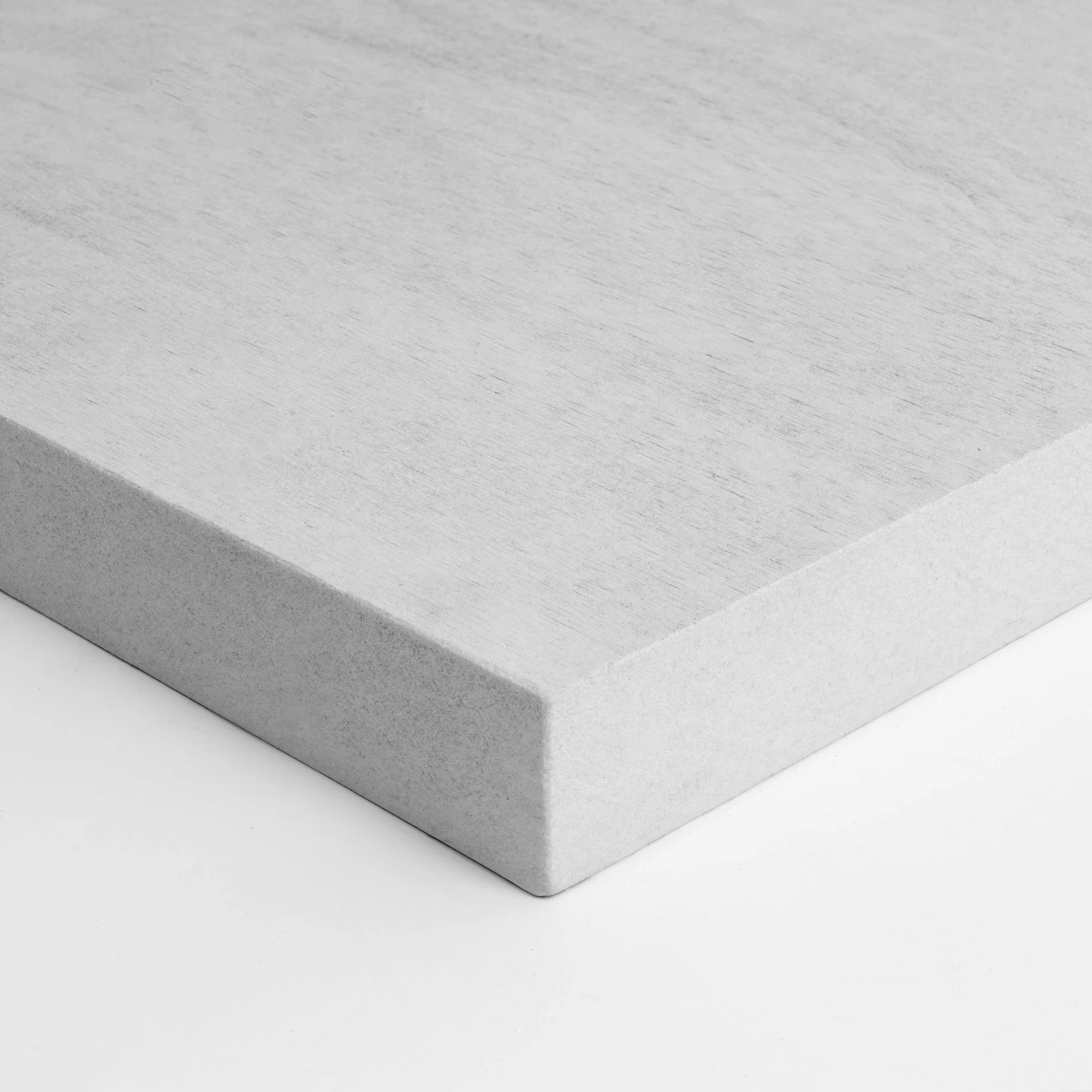
The board is a hydrated calcium silicate mineral — same chemistry as the bound phase in set cement, but in a high-porosity foam structure. Manufactured by autoclaving a lime + silica + water slurry under high pressure and heat. The result is roughly 90% porosity by volume, with pore sizes tuned for capillary activity.
230 kg/m³ density
Bulk density that delivers the moisture-buffering capacity. Higher than EPS (~30 kg/m³) or PIR (~35 kg/m³), comparable to wood fibre. The mass is what gives the board its moisture storage volume — a denser, more porous matrix can hold and release more water vapour per m².
100% inorganic mineral
No plastic content. No organic binder. No flame retardant chemistry. No formaldehyde resin. The board is calcium silicate hydrate, end of bill of materials. Cradle-friendly disposal — disposes with construction rubble, no hazardous-waste designation.
Alkaline pH ~10
The board surface sits at pH ~10 by chemistry, not by coating. Mould species need pH closer to neutral to colonise; calcium silicate's natural alkalinity is the inherent mould-resistance mechanism. The pH doesn't wash out or wear off — it's the chemistry of the board itself.
Fire: A1 non-combustible
Pure mineral matrix, no organic content, no contribution to fire. Euroclass A1 — the highest non-combustibility classification available. No 11 m external wall height restriction. Specifiable on leasehold mansion blocks and multi-occupancy buildings without EWS1 form friction or freeholder fire-engineering objection.
Manufactured in the Netherlands
Redstone manufactures the Clima Redboard Pro range at their facility in the Netherlands. European-made, short supply chain to UK projects (typically 1–2 weeks lead time from order). 100-year design life backed by manufacturer documentation.
100-year design life
Redstone publishes a 100-year design life for Clima Redboard Pro in standard internal wall service. The calcium silicate hydrate matrix is chemically stable mineral — it doesn't degrade, off-gas, embrittle, or lose performance over time. Set-and-forget fabric measure.
No annual service required
No moving part, no electrical component, no filter, and no consumable. Standard plastered-wall maintenance only — touch up dents and paint marks, redecorate on the homeowner's normal cycle. The capillary-active core needs nothing.
Decorate as a normal wall
Once plastered, the wall behaves like any plastered wall. Breathable paint (Earthborn, Graphenstone) preferred for full vapour-open assembly; standard emulsions work too. Wallpaper, hung pictures, fixed shelving — all supported. Heavy fixings (kitchen wall units) need fixings through the board into the masonry beyond.
Cold-bridge strip at reveals
A wall-plane IWI scope without insulated window reveals fails its U-value calculation around openings. Thinner Clima Redboard at 30 mm — or Spacetherm CBS where every millimetre of reveal matters — wraps jambs, soffits, sills, and lintels to break the thermal bridge. Without it, condensation reappears around windows on cold mornings.
Decentralised MVHR
Capillary-active calcium silicate buffers moisture peaks, but it isn't a substitute for ventilation. A decentralised MVHR unit per habitable room handles background moisture removal — iV-Compact or PRANA wall-mount where through-the-wall ducts are workable. The combination is what eliminates damp permanently, not the board alone.
Heating rebalance
An IWId room loses heat far more slowly than the existing radiator was sized for. The original radiator becomes oversized; the room overheats. A heating rebalance — typically lockshield valve adjustments across the existing system, occasionally a radiator downsize — restores even comfort. Included for one-room scopes; quoted separately for whole-floor work.
POA
40 m² boards plus reveal boards · delivered to UK site · install not included
POA
40 m² IWI scope · Victorian solid-brick property · two external elevations · gypsum plaster finish


_11zon%20(1).webp)
Call us at 07526 985258
or leave your contact information below,
and we'll get back to you soon.
We provide smart technology for homes and commercial spaces, ensuring transparent processes and optimal resource management.
Working hours: Mon - Sun. 8am - 8pm
Proudly serving the entire UK!
© 2026 Clever Bloom — All rights reserved
Company registered in England and Wales / Company number: 14242566.