


We provide smart technology for homes and commercial spaces, ensuring transparent processes and optimal resource management.
BASEMENT & CELLAR · CALCIUM SILICATE · CAPILLARY-ACTIVE
Calcium silicate insulation for damp basements and cellars · capillary-active · A1 non-combustible · 100-year design life
Engineered specifically for basements and cellars
100-year European track record · Since 1923
Pulls capillary moisture out of the wall surface
Capillary-active · 230 kg/m³ pore network
A1 non-combustible — clears escape-route fire rules
Cellar conversions to habitable rooms
Mould can't colonise an alkaline mineral surface
pH 10 · Anti-fungal by chemistry
Plasters direct — finishes like a normal wall
No vapour barrier · Lime or gypsum skim
100% mineral — no plastics, no resins, no off-gassing
Inorganic · 0 VOC · Cradle-friendly
Pairs with Multipor on the basement soffit
Same mineral family · A1 above too
100-year design life · Skamol founded in Denmark, 1923
A basement wall is half buried in earth. The earth side is at constant high relative humidity (~95%), the room side fluctuates with occupation. Capillary damp moves laterally through the masonry; surface temperature on the room face stays cold year-round. The result is a wall that's chronically prone to condensation, mould, and salt efflorescence — even on dry-feeling days.
Calcium silicate's micro-pore network actively pulls liquid water and water vapour into the board through capillary action. Where rigid foams or wood fibre resist condensation, calcium silicate manages it. The board becomes a continuous moisture buffer between the cold damp masonry and the warm room — moisture moves through the system rather than pooling at the surface.
SkamoWall is engineered at 230 kg/m³ — calibrated for higher capillary capacity than above-ground IWI variants. The denser pore network can hold and release more moisture per m² in sustained-wet conditions. The thermal conductivity penalty (λ 0.068 vs ~0.059 for standard IWI grades) is the trade-off; below ground, moisture management wins.
The board sits at pH ~10. Mould species need a pH closer to neutral and an organic food source to colonise — calcium silicate offers neither. Even when the surface is intermittently damp (which is its job in a basement environment), it doesn't develop the black-spot patterns that plague unconverted cellars. The anti-mould behaviour is chemistry, not a coating.
A converted basement becomes a habitable room — and habitable basements come with escape-route fire-engineering requirements. A1 non-combustible insulation clears the fire-class threshold without further assessment, where Class C aerogel or wood-fibre IWI would force the fire engineer to design a compensating measure. The single biggest spec advantage on cellar-to-habitable conversions.
Standard gypsum plaster (Thistle Multi-Finish) or lime plaster bonds directly to the calcium silicate face. No vapour barrier, no membrane, no special primer. Standard wallpaper, breathable paint, normal radiator and shelving fixings. After plaster cure the basement wall behaves like any other plastered wall — just dry, warm, and mould-free for the first time.
1 · Drainage & tanking review
Before any board fixing, the basement substrate is surveyed for active water ingress, broken external tanking, failed drainage, and sub-floor water sources. Where Type C waterproofing (drained cavity membrane plus sump and pump) is needed, that goes in first. SkamoWall sits on the dry side of any waterproofing system — never as a substitute for one.
2 · Substrate prep
Existing internal plaster, paint, or cementitious render removed back to masonry. Hygroscopic salt loading tested at sample points (basements typically carry significant salt history from historic damp episodes). Salt-affected areas treated with a salt-neutralising base render before SkamoWall is fitted.
3 · Adhesive bed
Skamol-specified mineral adhesive applied to the back of each board — full-coverage on uneven masonry. No air gap behind the board (an air gap defeats the capillary cycle in a basement environment). Boards pressed into the bed, plumbed, levelled, butted tight at joints.
4 · Mechanical fixings
Polymer plug-and-pin fixings drilled through the board into the masonry — more density than above-ground IWI because the substrate is often uneven brick or stone, and because the board is heavier per m². Typically 6–8 fixings per m² in basement applications.
5 · Joint reinforcement
Self-adhesive scrim tape over every butt joint and at perimeters. Corner beads at internal and external returns, mitred against floor and ceiling junctions. The scrim and the board face together give the plasterer a continuous, paper-tested surface to skim.
6 · Plaster finish
Lime plaster preferred for full vapour-open assembly (Mike Wye, Singleton Birch). Gypsum plaster (Thistle Multi-Finish) acceptable on conventional cellar conversions. Both bond directly to the calcium silicate face. Decorate with breathable paint or paper after a 4-week mist-coat cure.
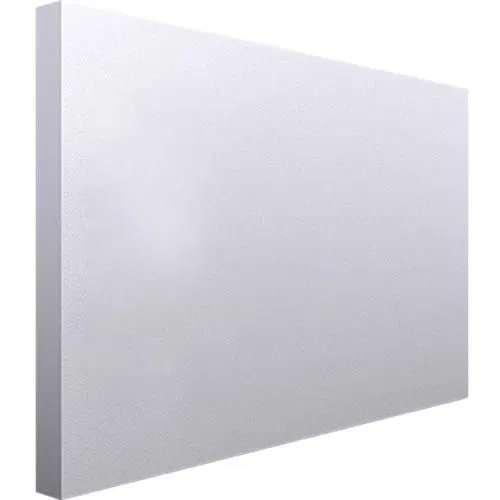
Calcium silicate hydrate matrix
The board is autoclaved calcium silicate hydrate — same mineral family as Redstone Clima Redboard, tuned for basement moisture handling. Manufactured by Skamol in Denmark since 1923 (originally for industrial high-temperature applications; SkamoWall is the construction-grade product line).
230 kg/m³ density
Higher than wall-grade calcium silicate IWI to deliver the capillary capacity needed for sustained-wet basement conditions. The pore network holds more moisture per m³, which is what allows the board to keep performing through the wetter months of the year without saturating.
100% inorganic mineral
No plastic content. No organic binder. No flame retardant chemistry. No formaldehyde resin. The board is calcium silicate hydrate, end of bill of materials. Cradle-friendly disposal — disposes with construction rubble, no hazardous-waste designation at demolition or removal.
Alkaline pH ~10
The board surface sits at pH ~10 by chemistry, not by coating. Mould species can't colonise; the pH doesn't wash out or wear off. Inherent anti-fungal behaviour, important in basement environments where surface humidity peaks during heavy weather.
Fire: A1 non-combustible
Pure mineral matrix, no organic content, no contribution to fire. Euroclass A1 — the highest non-combustibility class available. Cellar conversions to habitable rooms invoke escape-route fire-engineering review; A1 clears this without further measure.
Manufactured in Denmark
Skamol's manufacturing site has been operating since 1923 in Nykøbing Mors, Denmark. European-made, supply chain established. Sister product to Skamol's diatomaceous earth insulation range used in industrial high-temperature applications — same depth of mineral-insulation engineering experience.
100+ year design life
Skamol publishes a 100-year design life for SkamoWall in standard service. Industrial Skamol calcium silicate from the early 20th century is still in service in original applications. The mineral matrix doesn't degrade in basement service conditions.
No annual service required
No moving part, no electrical component, no filter, no consumable. The capillary-active core needs nothing. Standard plastered-wall housekeeping — touch up dents, redecorate on the homeowner's normal cycle.
Moisture reading at 6 months
CleverBloom includes a follow-up moisture-reading visit at 6 months post-install on every SkamoWall basement scope. Substrate moisture, surface RH, and any salt efflorescence checked at sample points across each wall. Establishes the baseline for ongoing performance and catches any unexpected drainage issues early.
Multipor on the soffit
A basement is a 5-sided thermal envelope. SkamoWall handles the walls; the ground-floor soffit above the basement is the other major cold surface. Xella Multipor mineral board on the soffit completes the envelope — same A1 mineral family, alkaline anti-mould chemistry, paintable white finish without plasterboard. CleverBloom usually quotes both as a single scope.
Decentralised MVHR
Capillary-active boards buffer moisture peaks, but they aren't a substitute for ventilation — moisture eventually has to leave the basement. Decentralised MVHR per habitable room handles background extraction. iV-Compact wall-mount where the basement has external wall access; PRANA wall-mount on thicker masonry. The combination is what makes a cellar permanently dry.
Floor build-up coordination
A cellar floor is a separate scope (typically limecrete or insulated screed over a vapour-control layer). The SkamoWall scope coordinates with the floor build-up so the wall-to-floor junction breaks the thermal bridge without creating a damp pocket. We sequence floor and wall work on the same project.
POA
30 m² boards delivered · install not included · for waterproofing specialists and self-builders
POA
30 m² basement scope · cellar-to-habitable conversion · gypsum or lime plaster finish


_11zon%20(1).webp)
Call us at 07526 985258
or leave your contact information below,
and we'll get back to you soon.
We provide smart technology for homes and commercial spaces, ensuring transparent processes and optimal resource management.
Working hours: Mon - Sun. 8am - 8pm
Proudly serving the entire UK!
© 2026 Clever Bloom — All rights reserved
Company registered in England and Wales / Company number: 14242566.